The pressure to cope with and navigate a child’s healthcare crisis
12/04/25
Families facing a child’s healthcare crisis often carry an invisible weight: the pressure to cope.
That pressure can silence grief and create isolation. Practical ways to navigate a crisis include tuning into emotions through journaling or therapy, keeping a small and trusted social circle, and advocating for emotional and practical needs.
These strategies are not about being demanding; they are about preserving capacity to care and ensuring humanity is not lost in the medical process. Letting go of perfection matters most. Presence, honesty, and asking for help are signs of strength, not weakness.
Dealing with our child’s healthcare journey – a personal take
From the moment my daughter Emily was diagnosed with a terminal illness, I felt a flood of emotions such as sadness, shock. But one emotion caught me off guard: pressure.
I remember sitting in one of those long multidisciplinary meetings, where the healthcare team explained, in overwhelming detail, the ins and outs of cancer treatment. It was a barrage of information, both clinical and logistical. And as the details piled up, so did the silent pressure. Crushing, stifling, relentless invisible pressure to handle everything perfectly.
I was gripped by a fear that I couldn’t afford to mess this up. My family was facing the biggest challenge of our lives, and I had to be perfect. I had to be the most present, most loving, most informed, most prayerful, most resilient person I had ever been. I had to be the most of everything. I was shaking with the weight of this pressure.
And yet, at that moment of diagnosis, when the healthcare team asked how we thought we would cope, I said something like, “We’re strong. We’ll face this.” I didn’t know how to say that I was breaking or how to ask for help. The pressure to cope, to be brave, to ‘get through it’ was overwhelming.
The unspoken burden
This burden wasn’t unique to me. It’s a common experience for families navigating serious illness; this pressure to keep going (Azhar et al., 2025). In healthcare settings, expressions of grief may get medicalised or minimised. Families may be praised for being ‘strong’ or ‘positive’, while deeper emotions such as anger, despair, and confusion may be felt as a sign of failure.
Also, if you’re in a public role (i.e. parent, professional, community leader), you may put another layer of pressure on yourself to handle a health crisis well. This can lead to emotional suppression and isolation, rather than connection and normalisation of grief experiences (Macdonald, 2024).
Things I slowly learnt in our healthcare crisis
Over time, I’ve gathered a few pieces of advice that helped me navigate this pressure. I’m speaking from my personal experience, however more structured approaches have been used in healthcare research (Eldesouky & Gross, 2024; Leung et al., 2023). This advice didn’t fix everything, but it slowly helped me build the space to breathe, to feel, and to ask for some help.
Tune into how you’re feeling
I found this hard to learn. It started with daily writing in a journal and being honest with myself. Writing down my experience:
- “I’m feeling under a lot of pressure to handle this.”
- “I feel angry that my daughter is dying.”
- “I am struggling in this health system.”
Writing these things was hard, and I felt guilty at times, or like I was a failure. But it was also freeing. It reminded me that I was a human and not a superhero. Difficult health journeys are part of the human experience, and they deserve space.
“Do not be ashamed of the intensity of your emotion.
Grief can be feral, wild, frightening.
Give it a safe place to live.”
(Smith, 2020, p. 134)
A safe space might include journaling, therapy, prayer, walking outside or simply calling a close friend. It is about allowing space for yourself to be honest.
Keep a small circle
One of the most helpful shifts was how I approached my social circle. When you’re under immense pressure, you may feel confused about how to share your story. Suddenly, people you hardly know, and even stranger, reach out with advice.
Sharing too widely while you’re in the thick of it can invite more opinions, more expectations, and more pressure. Another cancer mum, years ahead of me in her loss journey, said something I’ll never forget;
“My grief is my business.”
Her advice was to keep a small, trusted circle of people you can be real with. Everyone else gets the public version of the story that you feel ready to give. This ‘small circle’ boundary can help protect emotional energy during the crisis. It can give a safe space to process without performance.
Advocate for yourself and your family
Advocacy can feel impossible when you’re in shock or overwhelmed, but it matters. In those early days, I didn’t know what to ask for. The flood of information, the grief, the shock; it all silenced me.
But advocacy isn’t about confrontation. It’s about giving voice to your family’s needs in a system that can unintentionally overlook them. Sometimes, it’s as simple as saying:
- “Could we have another healthcare visit? We need more help.”
- “Can someone explain that again in plain language?”
- “We need privacy right now.”
Advocacy can also mean asking for practical help:
- A friend to cook a meal.
- A neighbour to drive you to the hospital.
- A family member to help look after your other children.
These small requests are not selfish; they are survival strategies. They create breathing space in a relentless process. If speaking up feels hard, maybe write your questions down before appointments or bring someone you trust to help you ask.
Remember: your voice matters. You are part of the care team, and your insight into your family’s needs is invaluable.
Let Go of Perfection
The pressure to cope often comes from a deeper place. It may be a desire to protect our loved ones, to do everything right, to be enough. I wanted to shield my daughter during her terminal illness, but perfection wasn’t realistic, or even the most needed thing. My presence was.
You don’t have to be the strongest, the most informed, or the most composed carer. You just have to be there. And sometimes, being there means taking time in private to articulate what’s going on for you. It means finding a few safe people. It means asking for help. It means saying, “I don’t know how to do this.”
None of those things are weakness. They mean you are human.
Final thoughts
If you are feeling the pressure to cope with your child’s healthcare crisis, know this: you are not alone. You don’t have to carry it all. You don’t have to perform superhuman strength. You are allowed to go through these normal human experiences: love, struggle, loss and grief.
To feel, to falter, and to find safe spaces.
I have written a book, The Suffering of a Child, recounting our own experience with Emily’s healthcare journey.
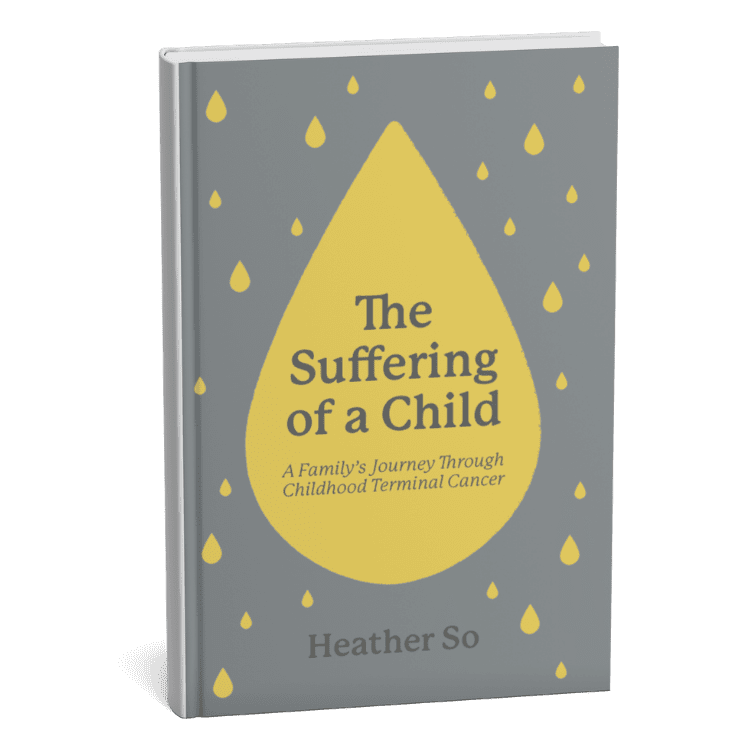
Read more about my academic work here, and explore my services for healthcare professionals.
References:
Azhar, S., Herrmann-Johns, A., Wolff, D., Rechenmacher, M., Kaiser, U., & Wasner, M. (2025). “ I can’t do it anymore”: a qualitative study on the emergence of crisis in outpatient palliative care—the perspective of family caregivers. BMC Palliative Care, 24(1), 39. doi:10.1186/s12904-025-01664-y
Eldesouky, L., & Gross, J. (2024). Using expressive writing to improve cancer caregiver and patient health: A randomized controlled feasibility trial. European journal of oncology nursing : the official journal of European Oncology Nursing Society, 70, 102578-102578. doi:10.1016/j.ejon.2024.102578
Leung, Y., Maslej, M., Ho, C., Razavi, S., Uy, P., Hosseini, M., Avery, J., Rodin, G. & Peterkin, A. (2023). Cocreating meaning through expressive writing and reading for cancer caregivers. Journal of palliative care, 38(3), 307-315. doi:10.1177/0825859719871538
Macdonald, M. (2024). Grief is a public health issue. Canadian Journal of Public Health, 115(3), 367-370. doi:10.17269/s41997-024-00898-2Smith, M. (2020). Keep moving: Notes on loss, creativity, and change. New York: One Signal.


